Comparing FIFA World Cup 2026 Stadiums: Facilities, Capacity and Fan Experience
The countdown is finally over, and the largest sporting spectacle on Earth has arrived as the 2026 tournament kicks off across North America. Featuring 48 teams competing across three vibrant host nations—the United States, Mexico, and Canada—fans from around the globe are experiencing an unprecedented level of football passion. When planning to attend these historic matches, Comparing FIFA World Cup 2026 Stadiums: Facilities, Capacity and Fan Experience becomes the ultimate guide for spectators. From cutting-edge retractable roofs to legendary historic arenas, each of the 16 host stadiums offers something unique for travelers, families, and die-hard supporters alike.
Therefore, understanding how these venues stack up against each other is crucial for optimizing your travel itinerary. In this comprehensive guide, we will analyze the capacity, modern facilities, pitch types, and overall matchday environments of all 16 locations. Whether you are looking for the electrifying noise of Mexico City or the futuristic luxury of Los Angeles, this analysis covers everything you need to know.
Table of Contents
- 1. US Stadiums: Innovation and Massive Scale
- 2. Mexico Stadiums: Football Heritage and Historic Atmosphere
- 3. Canada Stadiums: Modern Infrastructure and Intimate Venues
- 4. Stadium Features Comparison Matrix
- 5. High-Tech Facilities and Pitch Transformations
- 6. Designing the Ultimate Spectator Journey: Transit and Hospitality
- 7. Conclusion and Final Takeaways
- 8. Frequently Asked Questions (FAQ)
Comparing FIFA World Cup 2026 Stadiums: Facilities, Capacity and Fan Experience in the United States
The United States is hosting the majority of the tournament’s matches, utilizing 11 world-class venues primarily designed for American football (NFL). Indeed, when Comparing FIFA World Cup 2026 Stadiums: Facilities, Capacity and Fan Experience, the sheer scale and premium luxury of these American structures stand out as global benchmarks. Most of these venues have undergone significant adjustments, including widening their pitches and replacing artificial turf with advanced natural grass systems to comply with strict FIFA guidelines.
New York New Jersey Stadium (MetLife Stadium)
Located in East Rutherford, New Jersey, just across the Hudson River from Manhattan, the New York New Jersey Stadium boasts an official tournament capacity of 80,663. As the chosen venue for the highly anticipated World Cup Final, this massive open-air bowl offers top-tier corporate hospitality packages and expansive outer concourses. However, because it lacks a roof, spectators should prepare for varying summer weather conditions. Despite this, its proximity to New York City makes it a premier destination for international tourists looking to combine elite sports with world-class sightseeing.
Dallas Stadium (AT&T Stadium)
Often referred to as “Jerry World” due to its monumental scale, the Dallas Stadium in Arlington, Texas, features an official tournament capacity of 70,649, though it can expand significantly for mega-events. By Comparing FIFA World Cup 2026 Stadiums: Facilities, Capacity and Fan Experience, Dallas stands out as a marvel of modern sports engineering. It features a retractable roof that ensures absolute climate control, protecting fans from the intense Texas summer heat. Moreover, its iconic center-hung HD video board—one of the largest in the world—ensures that every spectator has a crystal-clear view of the action, regardless of where they are seated.
Los Angeles Stadium (SoFi Stadium)
SoFi Stadium, designated as the Los Angeles Stadium for the tournament, features a capacity of 70,492. Built in Inglewood, California, this architectural masterpiece features an indoor-outdoor design sheltered by a translucent canopy. A highlight of the fan experience here is the dual-sided, oval-shaped Infinity Screen by Samsung, which wraps around the inner bowl. For instance, while Comparing FIFA World Cup 2026 Stadiums: Facilities, Capacity and Fan Experience, one must consider how SoFi’s luxurious executive suites and premium dining options raise the bar for VIP hospitality. However, public transit connections to the site remain a key point of planning for international travelers.
Atlanta Stadium (Mercedes-Benz Stadium)
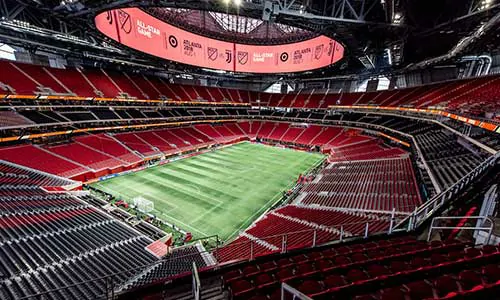
With a tournament capacity of 68,239, Atlanta Stadium is renowned for its striking pinwheel retractable roof and massive 360-degree “Halo” video board. This venue is widely praised for its fan-friendly food pricing, offering high-quality concessions at highly affordable rates. Consequently, Comparing FIFA World Cup 2026 Stadiums: Facilities, Capacity and Fan Experience demonstrates that Atlanta excels at delivering value-focused, high-tech matchday experiences. Furthermore, its urban location in downtown Atlanta provides seamless access to local subway systems (MARTA), making it incredibly easy for fans to navigate.
Other Notable US Venues
- Miami Stadium (Hard Rock Stadium): Hosting a capacity of 64,478, this vibrant open-air venue features a canopy roof covering 90% of the seating area, keeping fans cool under the Florida sun.
- Seattle Stadium (Lumen Field): With a capacity of 66,925, this stadium is legendary for its steep seating bowl, which traps sound and creates one of the loudest, most intimidating atmospheres in North American sports.
- San Francisco Bay Area Stadium (Levi’s Stadium): Located in Santa Clara, this 68,827-capacity tech-forward venue emphasizes ecological sustainability, featuring a green roof and advanced solar panels.
- Houston, Kansas City, Boston, and Philadelphia: These historic sports cities provide high-capacity stadiums ranging from 64,000 to over 69,000 seats, each with highly passionate local sports cultures.
Comparing FIFA World Cup 2026 Stadiums: Facilities, Capacity and Fan Experience in Mexico
Mexico brings an unmatched footballing legacy to the 2026 tournament. It is the first country to host matches across three different editions of the World Cup (1970, 1986, and 2026). When Comparing FIFA World Cup 2026 Stadiums: Facilities, Capacity and Fan Experience, the Mexican venues focus heavily on deep-rooted passionate atmospheres, historic charm, and distinct regional gastronomy.
Mexico City Stadium (Estadio Azteca)
No stadium in world football carries more history than Estadio Azteca, designated as the Mexico City Stadium. Sporting a tournament capacity of 80,824, this historic venue hosted the legendary feats of Pelé in 1970 and Diego Maradona in 1986. While it may lack some of the ultra-modern luxury features found in newly built US arenas, the sheer energy and roaring crowd noise make it an unmatched environment. In addition, Comparing FIFA World Cup 2026 Stadiums: Facilities, Capacity and Fan Experience highlights how Azteca’s historic design places fans remarkably close to the pitch, making every goal feel earth-shattering.
Monterrey Stadium (Estadio BBVA)
Nestled against the dramatic backdrop of the Cerro de la Silla mountain, Monterrey Stadium (Estadio BBVA) has a tournament capacity of 51,243. Often nicknamed “The Steel Giant,” this stadium is celebrated as one of the most visually beautiful sports structures in the world. Meanwhile, Comparing FIFA World Cup 2026 Stadiums: Facilities, Capacity and Fan Experience illustrates that Monterrey successfully blends modern comforts with spectacular sightlines, offering a highly comfortable and aesthetically pleasing matchday journey for international travelers.
Guadalajara Stadium (Estadio Akron)
With a capacity of 45,664, Guadalajara Stadium (Estadio Akron) features an innovative design resembling an active volcano topped by a cloud-like roof. This eco-friendly venue is surrounded by green spaces and utilizes advanced rainwater harvesting systems. As a result, Comparing FIFA World Cup 2026 Stadiums: Facilities, Capacity and Fan Experience helps us identify Guadalajara as a leader in sustainable stadium architecture, offering an intimate yet incredibly passionate stadium environment.
Comparing FIFA World Cup 2026 Stadiums: Facilities, Capacity and Fan Experience in Canada
Canada is making its historic debut as a men’s World Cup co-host, offering two distinct venues on opposite sides of the country. Consequently, Comparing FIFA World Cup 2026 Stadiums: Facilities, Capacity and Fan Experience showcases Canada’s unique indoor-outdoor architectural wonders, catering to both coastal and urban fanbases.
BC Place Vancouver
Situated in the heart of British Columbia, BC Place Vancouver features a tournament capacity of 52,497. The stadium’s defining feature is its cable-supported retractable roof, which is the largest of its kind in the world. When open, the beautiful Pacific Northwest sunshine illuminates the pitch, while its closed-roof setting guarantees a loud, echo-filled atmosphere. Moreover, Comparing FIFA World Cup 2026 Stadiums: Facilities, Capacity and Fan Experience demonstrates how BC Place’s central downtown location makes it highly walkable, allowing fans to transition seamlessly from local restaurants and hotels straight to their seats.
Toronto Stadium (BMO Field)
With a tournament capacity of 43,036, Toronto Stadium (traditionally BMO Field) is the most intimate venue of the 2026 tournament. Located at Exhibition Place, just minutes from downtown Toronto, this outdoor stadium has been temporarily expanded to meet FIFA’s seating requirements. While it lacks the massive capacity of MetLife or Azteca, its compact design ensures that spectators are incredibly close to the pitch. Therefore, Comparing FIFA World Cup 2026 Stadiums: Facilities, Capacity and Fan Experience is not just about the size of the crowd, but also the rare closeness to the players that Toronto uniquely provides.
Stadium Features Comparison Matrix
To help you digest all of this information, the following comparison table simplifies the core differences across these iconic host venues. This matrix focuses on Comparing FIFA World Cup 2026 Stadiums: Facilities, Capacity and Fan Experience using finalized operational data.
| Stadium Name (FIFA) | Host City | Final Capacity | Roof Type | Key Fan Feature |
|---|---|---|---|---|
| New York New Jersey Stadium | East Rutherford, NJ | 80,663 | Open-Air | World Cup Final Host Venue |
| Dallas Stadium | Arlington, TX | 70,649 | Retractable | Massive center-hung HD Screen |
| Los Angeles Stadium | Inglewood, CA | 70,492 | Fixed Translucent Canopy | Double-sided Samsung Infinity Screen |
| Mexico City Stadium | Mexico City, MX | 80,824 | Open-Air | Historic soccer legacy & noise |
| BC Place Vancouver | Vancouver, CAN | 52,497 | Retractable Cable Roof | Highly walkable downtown access |
High-Tech Facilities and Pitch Transformations
One of the most complex challenges of organizing a unified North American tournament is standardizing the playing surfaces. Many NFL stadiums in the United States normally utilize artificial turf, which is prohibited for senior FIFA Men’s World Cup matches. Therefore, stadiums such as Dallas Stadium, Atlanta Stadium, and Seattle Stadium have installed temporary natural grass pitches engineered with sophisticated root-growth technology and under-soil ventilation. These systems ensure that the grass remains healthy and durable under the heavy load of a World Cup schedule.
Additionally, visual technology plays a massive role in modern spectator engagement. The massive digital screens found in Los Angeles (SoFi’s Infinity Screen) and Atlanta (the Halo Board) provide real-time statistics, multi-angle replays, and immersive graphics. On the other hand, traditional stadiums like Estadio Azteca emphasize classic architecture, proving that historical gravity can be just as powerful as digital screens when keeping fans engaged.
Designing the Ultimate Spectator Journey: Transit and Hospitality
An often overlooked aspect when Comparing FIFA World Cup 2026 Stadiums: Facilities, Capacity and Fan Experience is the ease of traveling to and from the venue on matchday. Because North American cities are highly spread out, the transit experience varies wildly between host cities. For example, Seattle, Atlanta, and Vancouver offer direct light rail or subway connections that drop fans off right outside the stadium gates. This makes public transit the quickest and most stress-free option for travelers.
Conversely, suburban stadiums like those in Dallas (Arlington) and San Francisco (Santa Clara) rely heavily on ridesharing services, organized shuttle buses, and massive parking lots. In these locations, the classic American “tailgating” culture takes center stage, with thousands of fans gathering in the parking areas hours before kick-off to grill food and socialize. Meanwhile, the luxury hospitality experiences across all venues have reached new heights, with top-tier suites offering fine dining, climate-controlled viewing areas, and dedicated concierge services.
Conclusion and Final Takeaways
In conclusion, Comparing FIFA World Cup 2026 Stadiums: Facilities, Capacity and Fan Experience reveals a tournament designed to set new benchmarks for global sports events. If you are looking for ultra-modern luxury and futuristic stadium design, US venues like Los Angeles and Dallas are hard to beat. If you crave intense football history and a roaring, passionate atmosphere, Mexico City’s Estadio Azteca remains the undisputed crown jewel. Finally, for scenic, walkable, and friendly fan environments, Canadian hosts like Vancouver and Toronto provide a highly welcoming experience.
As you prepare for this historic tournament, make sure to plan your transit options early and secure your official match tickets through authorized channels. For more detailed guides on match schedules and host cities, explore the official FIFA Website and stay updated with the comprehensive tournament outline on Wikipedia. Choose your venues wisely, prepare for the summer heat, and enjoy the beautiful game!
Frequently Asked Questions (FAQ)
Below are some of the most common questions regarding our analysis of Comparing FIFA World Cup 2026 Stadiums: Facilities, Capacity and Fan Experience.