Football Position Numbers Explained: The Meaning of 1 to 11
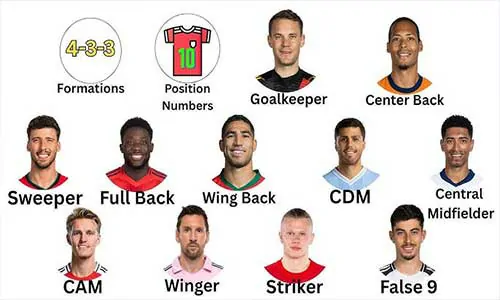
Have you ever watched a football match and wondered why certain players wear specific shirt numbers? While modern squad numbering allows players to choose almost any number from 1 to 99, the classic numbering system remains the foundation of tactical discussion. Understanding these numbers can completely change how you analyze a match. In this comprehensive guide, we have the Football Position Numbers Explained: The Meaning of 1 to 11 to help you decode the roles, responsibilities, and history behind each classic shirt number on the pitch.
Whether you are a casual fan wanting to understand the commentator’s tactical jargon or an aspiring player trying to master your role, knowing these traditional positions is essential. Therefore, let us dive deep into the classic lineup and explore what each number truly signifies in the beautiful game.
Table of Contents
- The History of Football Shirt Numbers
- Quick Reference: Football Position Numbers 1 to 11
- Number 1: The Goalkeeper
- Number 2: The Right-Back
- Number 3: The Left-Back
- Number 4: The Center-Back / Defensive Midfielder
- Number 5: The Center-Back
- Number 6: The Defensive Midfielder
- Number 7: The Right Winger / Second Striker
- Number 8: The Box-to-Box Midfielder
- Number 9: The Striker / Center Forward
- Number 10: The Attacking Midfielder / Playmaker
- Number 11: The Left Winger
- How Modern Systems Modify the Traditional Football Position Numbers Explained: The Meaning of 1 to 11
- Frequently Asked Questions (FAQs)
- Conclusion and Final Thoughts
The History of Football Shirt Numbers
Before shirt numbers became permanent squad identifiers, they were used strictly to denote a player’s starting position on the field. This system was first trialed in England in 1928 during a match between Chelsea and Arsenal. By the 1933 FA Cup Final, the system became standard practice, with one team wearing numbers 1 to 11 and the opposing team wearing 12 to 22.
Traditionally, teams lined up in a classic 2-3-5 formation (known as the “Pyramid” formation). As tactics evolved into the standard 4-4-2 and 4-3-3 formations, the numbers shifted but largely kept their original associations with specific areas of the pitch. Consequently, even today, when a manager refers to playing a “number 6” or a “number 10,” they are discussing tactical roles rather than literal shirt numbers.
For more details on how these historical systems developed, you can read the comprehensive overview on Wikipedia’s Squad Number Guide.
Quick Reference: Football Position Numbers 1 to 11
To help you visualize the traditional layout, here is a quick summary of the classic 1 to 11 positions as they are typically understood in a standard 4-4-2 or 4-3-3 formation:
| Shirt Number | Traditional Position | Key Responsibilities | Famous Examples |
|---|---|---|---|
| 1 | Goalkeeper | Shot-stopping, distribution, organizing defense | Manuel Neuer, Lev Yashin, Gianluigi Buffon |
| 2 | Right-Back | Defending the right flank, overlapping runs | Gary Neville, Cafu, Kyle Walker |
| 3 | Left-Back | Defending the left flank, crossing, overlapping | Paolo Maldini, Roberto Carlos, Ashley Cole |
| 4 | Center-Back | Interceptions, aerial duels, physical defense | Virgil van Dijk, Sergio Ramos |
| 5 | Center-Back (Sweeper) | Ball distribution from deep, organization | Franz Beckenbauer, Carles Puyol |
| 6 | Defensive Midfielder | Shielding defense, regaining possession, short passing | Sergio Busquets, Claude Makélélé, Rodri |
| 7 | Right Winger | Pace, crossing, dribbling, creating chances | Cristiano Ronaldo, David Beckham |
| 8 | Box-to-Box Midfielder | Transitioning play, stamina, assisting and defending | Steven Gerrard, Andres Iniesta, Toni Kroos |
| 9 | Striker / Center Forward | Scoring goals, holding up the ball, physical presence | Erling Haaland, Robert Lewandowski, Ronaldo Nazário |
| 10 | Attacking Midfielder | Playmaking, vision, key passes, scoring from distance | Lionel Messi, Diego Maradona, Zinedine Zidane |
| 11 | Left Winger | Dribbling, crossing, counter-attacking | Ryan Giggs, Ronaldinho, Neymar Jr. |
Number 1: The Goalkeeper
The Number 1 is the most straightforward jersey on the pitch. Reserved exclusively for the starting goalkeeper, this position is the last line of defense. The primary duty of the goalkeeper is to prevent the ball from crossing the goal line using any part of their body.
However, the modern game has completely transformed the goalkeeper’s responsibilities. In addition to traditional shot-stopping and aerial dominance, contemporary “sweeper-keepers” must possess excellent footwork. They are expected to initiate attacks from the back, distribute accurate long balls, and sometimes play outside their penalty area to clear defensive threats.
- Primary Role: Protecting the goal and organizing the defensive line.
- Key Attributes: Reflexes, communication, aerial ability, positioning, and distribution.
Number 2: The Right-Back
Traditionally, the Number 2 is worn by the starting right-back. Historically, this player was purely defensive, tasked with stopping opposing wingers from crossing or cutting inside. They were expected to stay deep and maintain the shape of the backline.
In modern tactical setups, the right-back is often a highly dynamic player. They must possess incredible stamina to sprint up and down the right flank, providing width in attack while quickly recovering to fulfill their defensive duties. Consequently, players like Cafu and Kyle Walker have redefined this role as a dual-threat position.
- Primary Role: Defending the right wing and supporting attacking moves.
- Key Attributes: Stamina, tackling, crossing, speed, and positioning.
Number 3: The Left-Back
Mirroring the right-back, the Number 3 is traditionally assigned to the starting left-back. This player is responsible for defending the left side of the pitch. Just like their counterpart on the right, the modern left-back must be comfortable joining the attack, overlapping the left winger, and delivering precise crosses into the box.
Furthermore, because left-footed players are less common, a high-quality Number 3 is incredibly valuable. They help maintain the team’s tactical balance and can stretch the opponent’s defense by keeping the play wide on the left flank.
- Primary Role: Shutting down opposition attacks on the left and assisting in wide offensive plays.
- Key Attributes: Left-foot dominance, crossing, speed, defensive awareness, and work rate.
Number 4: The Center-Back / Defensive Midfielder
The assignment of the Number 4 shirt historically varied depending on regional preferences. In English football, the Number 4 was often worn by a defensive midfielder or a deep-lying playmaker. Meanwhile, in continental Europe and South America, it was typically reserved for one of the starting central defenders.
Today, when viewed as a central defender, the Number 4 is expected to be a dominant, physical presence. They must excel in aerial duels, command the penalty box, and execute clean tackles to break up play. On the other hand, when used as a defensive midfielder, the player acts as a link between the defense and the midfield engine room.
- Primary Role: Central defensive duties or deep midfield screening.
- Key Attributes: Strength, tackling, heading, composure, and tactical discipline.
Number 5: The Center-Back
The Number 5 is almost universally recognized as the shirt of the primary center-back. Traditionally, this player acts as the anchor of the defense, often playing alongside the Number 4. In older systems, the Number 5 sometimes acted as a “sweeper” (or *libero*), playing slightly behind the rest of the defensive line to clean up loose balls.
Moreover, the modern Number 5 is no longer just a rugged defender. They must be highly comfortable on the ball, initiating build-up play under high pressure and passing accurately to the midfielders. Leaders like Carles Puyol and Fabio Cannavaro perfectly embodied this blend of aggression and intelligence.
- Primary Role: Central defense, leadership, and playing out from the back.
- Key Attributes: Leadership, anticipation, physical strength, and passing accuracy.
Number 6: The Defensive Midfielder
The Number 6 is the heartbeat of a team’s defensive structure. Positioned directly in front of the central defenders, the “number six” acts as a shield. Their main objective is to disrupt opposing attacks, intercept passes, and recover possession as quickly as possible.
Once they win the ball back, they must distribute it safely to more creative teammates. Therefore, players in this position require incredible tactical intelligence and positional discipline. Rather than chasing the ball everywhere, they hold their position to prevent counter-attacks.
- Primary Role: Breaking up opposition plays and securing the defensive midfield zone.
- Key Attributes: Interceptions, stamina, tactical intelligence, short passing, and positioning.
Number 7: The Right Winger / Second Striker
The Number 7 is one of the most iconic shirts in football history, often associated with flair, creativity, and match-winning talent. Traditionally, this number belongs to the right winger. Their primary role is to run down the right touchline, beat defenders with speed or skill, and deliver crosses into the box.
However, over the years, the Number 7 has also been worn by second strikers and highly influential playmakers who wander across the attacking third. It is a shirt that carries immense pressure and expectation, famously worn by legends such as Cristiano Ronaldo at Manchester United and Real Madrid.
- Primary Role: Creating and scoring goals from wide or central attacking areas.
- Key Attributes: Dribbling, crossing, acceleration, creativity, and finishing.
Number 8: The Box-to-Box Midfielder
If the Number 6 is the anchor, the Number 8 is the engine. Traditionally a box-to-box midfielder, this player is expected to contribute heavily in both penalty boxes. They assist the defense in winning the ball and immediately sprint forward to support the attack.
As a result, a great Number 8 must have an unparalleled work rate and exceptional stamina. They need to be versatile enough to make a sliding tackle in their own half and, moments later, arrive late in the opposition box to score a clinical goal. Iconic players like Steven Gerrard and Frank Lampard set the standard for this demanding role.
- Primary Role: Linking defense and attack through tireless running and smart passing.
- Key Attributes: Stamina, long-range shooting, passing range, tackling, and vision.
Number 9: The Striker / Center Forward
The Number 9 is the ultimate goalscorer’s shirt. Worn by the central striker, this player’s primary responsibility is simple: put the ball in the back of the net. They are the focal point of the team’s attack and usually stay closest to the opponent’s goal.
In traditional setups, the Number 9 was often a physical “target man” who could hold off defenders, win aerial duels, and lay the ball off to oncoming midfielders. While modern strikers like Erling Haaland still possess these physical traits, they must also be highly mobile, pressing defenders and making runs behind the defensive line.
- Primary Role: Finishing attacking moves and scoring goals.
- Key Attributes: Clinical finishing, movement, strength, aerial ability, and composure.
Number 10: The Attacking Midfielder / Playmaker
No shirt in football holds more prestige than the Number 10. Traditionally assigned to the team’s primary playmaker (or *trequartista*), this player operates in the “pocket” between the opposition’s midfield and defense. They are the creative mastermind of the squad.
A classic Number 10 possesses extraordinary vision, close control, and the ability to unlock compact defenses with a single pass. Furthermore, they are often expected to score goals from distance and execute set-pieces with precision. Legends like Pelé, Diego Maradona, and Lionel Messi have made this number legendary.
- Primary Role: Creating scoring opportunities and pulling the strings in the final third.
- Key Attributes: Vision, dribbling, passing accuracy, creativity, and football IQ.
Number 11: The Left Winger
The Number 11 shirt is traditionally reserved for the starting left winger. Much like the right winger, their role is to provide width, speed, and crossing ability. However, they operate on the left flank, meaning they are typically left-footed players who look to beat their defender on the outside to deliver crosses.
In modern football, many managers prefer “inverted wingers.” This means a right-footed player might wear the Number 11 shirt and play on the left flank, allowing them to cut inside onto their stronger foot to shoot. Regardless of the tactical approach, the Number 11 remains a symbol of direct attacking threat and explosive pace.
- Primary Role: Attacking down the left flank, crossing, and cutting inside to shoot.
- Key Attributes: Pace, crossing, agility, dribbling, and off-the-ball movement.
How Modern Systems Modify the Traditional Football Position Numbers Explained: The Meaning of 1 to 11
Tactics in the modern era are fluid, and rigid positioning is becoming less common. Consequently, modern managers frequently adjust these classic roles to create a competitive advantage. For instance, the rise of the “false nine” has completely shifted the traditional Number 9 role. Instead of staying high up the pitch, a false nine drops deep into midfield, dragging defenders out of position and creating space for wingers to exploit.
Similarly, the “inverted full-back” is another modern tactical innovation. Under managers like Pep Guardiola, full-backs (traditionally Numbers 2 and 3) often drift inside during possession to act as central midfielders. This tactic creates numerical superiority in the middle of the park while maintaining defensive stability against counter-attacks.
Furthermore, squad numbers are no longer strictly tied to starting positions. Players often choose numbers based on personal preference or marketing reasons. Nevertheless, whenever coaches analyze opponents or describe tactical roles, they still rely heavily on the 1 to 11 framework. If you wish to study modern tactical evolutions in depth, you can check out the latest analyses on FIFA’s official website.
Frequently Asked Questions (FAQs)
1. What is a “False Nine” in football?
A “false nine” is an unconventional striker (traditionally wearing Number 9) who regularly drops deep into the midfield instead of staying in the box. This movement confuses the opposing central defenders, pulling them out of position and leaving open space for wingers (Numbers 7 and 11) to run into and score.
2. Why do some players wear high numbers like 45 or 99?
In modern club football, squad numbering is permanent for the entire season, allowing players to choose any number from 1 to 99. Some players select high numbers because their preferred traditional number is taken, or they choose numbers based on personal superstitions, birth years, or marketing choices.
3. Can a goalkeeper wear a number other than 1?
Yes, goalkeepers can wear other numbers, especially substitute goalkeepers who often wear 12, 13, 22, or 25. However, in major international tournaments governed by FIFA, squad numbers are often restricted from 1 to 23, with Number 1 almost always reserved exclusively for a goalkeeper.
4. What is the difference between a Number 6 and a Number 8?
A Number 6 is primarily a defensive midfielder who sits deep, protects the defense, and focuses on winning back possession. On the other hand, a Number 8 is a box-to-box midfielder who actively participates in both defending and attacking, requiring higher stamina and offensive creativity.
5. Why is the Number 10 shirt considered so special?
The Number 10 shirt is prestigious because it was historically worn by the team’s most creative and talented player—the playmaker. Because legends like Pelé, Maradona, and Messi wore this number, it became synonymous with footballing genius, leadership, and match-winning ability.
6. What are the traditional numbers for central defenders?
Traditionally, central defenders wear the Number 4 and Number 5 shirts. They form the core of the defensive line, with one often acting as a physical stopper and the other playing a more tactical, sweeping role.
Conclusion and Final Thoughts
In conclusion, having the Football Position Numbers Explained: The Meaning of 1 to 11 provides a fantastic foundation for understanding the game’s tactical evolution. While modern formations have become highly fluid and squad numbering is more flexible than ever, the traditional roles associated with numbers 1 through 11 still dictate how teams are built and how coaches communicate their strategies.
By understanding what these positions represent, you can appreciate the subtle movements and tactical battles occurring on the pitch during any match. What is your favorite position to play or watch? Let us know in the comments below, and don’t forget to share this guide with fellow football enthusiasts!